Positive energy neighbourhoods in practice: Evidence from Genk, Pamplona and Tartu
Guest/partner contributor
Posted on: 21 May 2026
Positive energy neighbourhoods are a key instrument in the transition to climate neutrality, writes Lisa Marie Hanß.
Cities and urban environments in Europe comprise over 100 million buildings and account for around 40% of the continent’s greenhouse gas emissions, much of which is driven by poor energy performance.
Indeed, approximately 75% of Europe’s building stock is considered energy inefficient. Achieving climate neutrality therefore depends on successfully transforming urban neighbourhoods and their energy systems.
Positive energy neighbourhoods (PENs) are a key instrument in this transition. They combine energy efficient buildings, local renewable energy generation and system flexibility to create neighbourhoods that generate more energy than they consume. As such, they represent a vital tool in advancing Europe’s goals of climate neutrality and economic competitiveness, turning cities into engines of green growth, strategic resilience and local economic thriving1. But how does this work in practice?
Three city pathways to positive energy neighbourhoods
In Genk, Belgium, a resident notices their Loomy lamp glowing green. It means that solar energy from the roof is currently available. It is the ideal moment to run the dishwasher or do the laundry.
Hundreds of kilometres away in Pamplona, Spain, residents gather around a once ordinary wall to paint a large mural. Through this collective effort, they express climate awareness, community identity and a neighbourhood in transition.
In Tartu, Estonia, an apartment association board member has successfully convinced her neighbours to fully renovate their apartment building. She now shares practical insights from the renovation process with other residents and housing associations.
These snapshots illustrate the diversity of approaches to positive energy neighbourhood development across Europe. Through the oPEN Lab project, three neighbourhoods in Tartu, Pamplona and Genk are being transformed into living labs. In each case, residents, local authorities, universities, businesses and technical experts collaborate to deliver neighbourhoods that produce more energy than they consume.
Beyond technical solutions, oPEN Lab also invests in people: integrating technology with art, culture and local engagement to foster ownership, trust and a shared sense of purpose in the energy transition.
Renovation as a foundation for energy efficient living
A central pillar of positive energy neighbourhood development is deep building renovation, implemented in ways that minimise disruption while maximising performance.
Genk: industrialised renovation and living laboratories
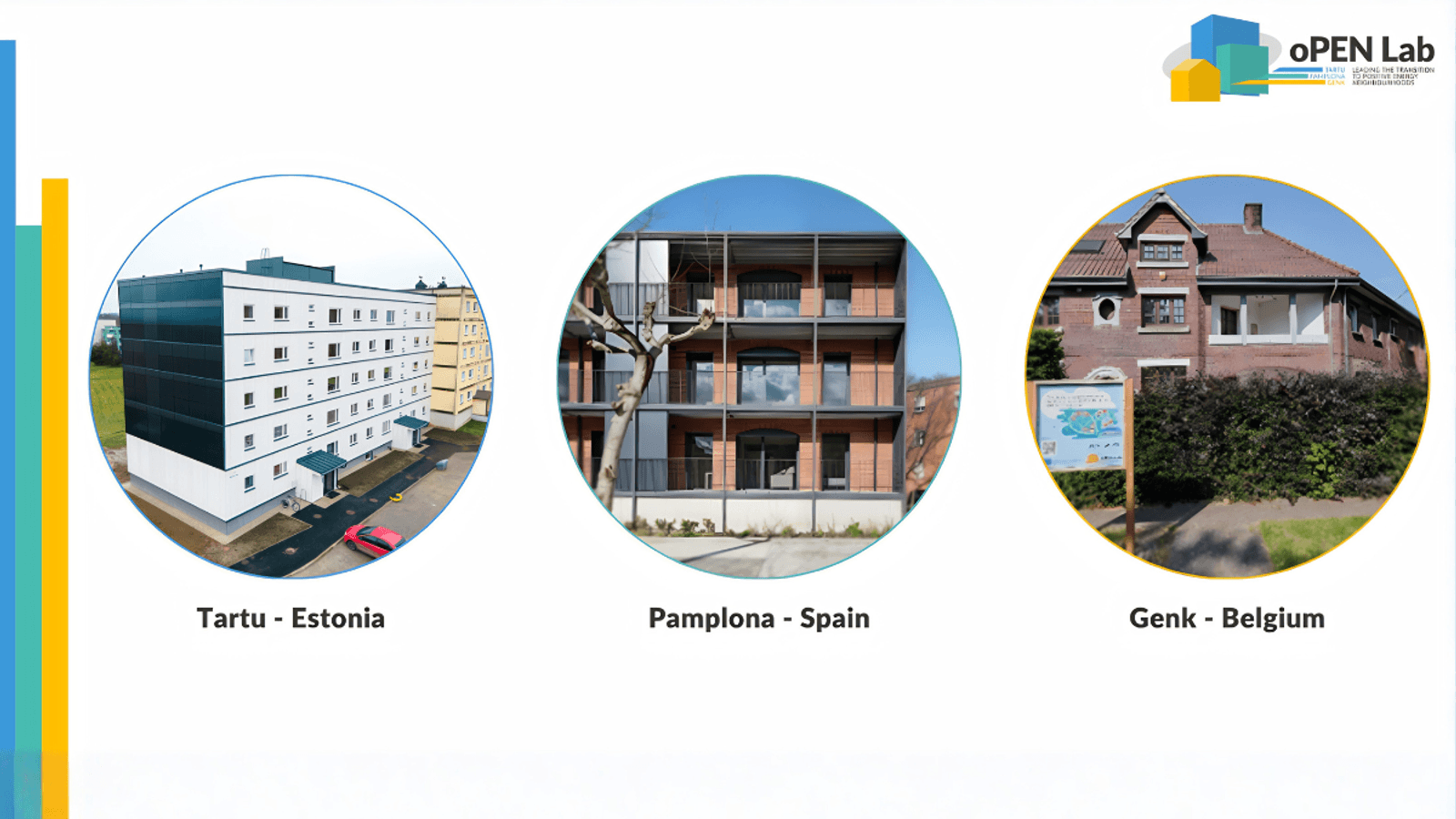
In Genk, both social housing and privately owned homes are being retrofitted, often while residents remain in place. In the Nieuw Texas neighbourhood, 27 social housing units managed by Wonen in Limburg were renovated using industrialised techniques, such as prefabricated façade panels and a modular energy box pre-integrated with a heat pump, ventilation system and buffer tank. The works were completed in an average of eight weeks per dwelling
In Waterschei, seven privately owned test houses function as a living laboratory. Each applies a different combination of technologies, materials and user practices. Solutions include geothermal heat pumps, underfloor heating, heat recovery ventilation (system D), photovoltaic systems, home batteries, smart energy management and electric vehicle charging. This setup allows for the evaluation of both individual technologies and integrated system performance, while incorporating user feedback to refine scalable renovation strategies.
Pamplona: integrated refurbishment and social inclusion
In Pamplona, the city council has led the refurbishment of the San Pedro complex, combining energy performance improvements with broader social and architectural upgrades. The project included the removal of accessibility barriers, installation of lifts and terraces, full replacement of building systems, and significant improvements to the building envelope.
A lightweight roof incorporating an integrated PV system now generates approximately 73MWh of electricity annually, corresponding to an estimated reduction of around 57t of CO₂ emissions per year. High performance industrialised façade panels further enhance thermal efficiency, contributing to long-term energy savings and improved living conditions.
Tartu: prefabrication and high performance retrofit
In Tartu’s Annelinn district, a five-storey apartment building has been transformed into an energy efficient social housing block. The renovation relied on factory prefabricated elements that integrate insulation, windows, ventilation systems and structural components. Building-integrated photovoltaics have been incorporated into façade panels, contributing to on-site renewable energy generation. As a result, the building has achieved energy class A, significantly reducing energy consumption while improving indoor comfort.
Co-creation as a driver of adoption
Across all three living labs, co-creation plays a central role in shaping and implementing renovation strategies.
In Pamplona, residents and community groups engage through inclusive cultural and artistic activities, often involving local schools. In Tartu, local working groups, information events and peer-to-peer exchanges help guide decision making and build trust. In Genk, open homes, guided tours and close collaboration with residents during renovation works generate real-time feedback on technologies and daily usage patterns.
These participatory processes ensure that solutions are socially accepted, replicable and aligned with local needs.
Lessons from oPEN Lab: governance and pathways to scale
Beyond individual interventions, oPEN Lab provides insights into how neighbourhood-scale energy transitions can be implemented under different local conditions. The examples in Genk, Pamplona and Tartu show that successful positive energy neighbourhood development depends not only on technological solutions, but also on governance frameworks, stakeholder collaboration and viable financing models.
oPEN Lab is making the case for positive energy neighbourhoods as a concrete and scalable way to deliver on Europe’s climate, energy and housing policy ambitions. The neighbourhood scale uniquely bridges the gap between EU regulation and on-the-ground action, integrating buildings, energy systems mobility and public space while keeping citizens at the heart of the transition.
About the author
Lisa Marie Hanß is a communication specialist at Steinbeis Europa Zentrum, where she supports several Horizon Europe and Horizon 2020 projects. She contributes to the design and implementation of communication and dissemination strategies and through her work helps strengthen the impact of European research projects by translating technical developments into clear, engaging and policy relevant messages.
Related tags
Most popular
Join the community for freeAnd get access to all content
Related projects
oPEN Lab
21 October 2021 - 20 April 2025
View projectLatest in Projects
All articles+1
E-NERGY Cluster returns to the EU Energy Projects Podcast ahead of EUSEW 2026
The EU Energy Projects Podcast welcomes back the E-NERGY Cluster for its second dedicated episode, bringing together representatives from EU-funded projects EU-DREAM, DIGITISE and CELINE to discuss one of the most pressing challenges of the energy transition: how to place citizens at the center of an increasingly digital energy system.
- Areti Ntaradimou
- 03/06/2026