Home
/
Brussels unveils European Grids Package to supercharge cross-border energy infrastructure
Brussels unveils European Grids Package to supercharge cross-border energy infrastructure
Yusuf Latief
Posted on: 10 December 2025
European Grids Package and Energy Highways initiative look to enhance European energy infrastructure while bolstering its resilience and security.
The European Commission has released its set of proposals for the European Grids Package and the Energy Highways initiative, aiming to create a better-connected Europe-wide energy infrastructure network.
The Package proposes to simplify the process for selecting Projects of Common Interest (PCIs) and Projects of Mutual Interest (PMIs), while also including projects that make infrastructure smarter and include security upgrades under the Trans-European Networks for Energy Regulation (TEN-E) infrastructure categories.
This would enable such projects to benefit from EU financial support from the Connecting Europe Facility (CEF), for which its Energy budget is proposed to increase by five times its current amount, from €5.8 billion ($6.8 billion) to €29.9 billion ($34.8 billion).
Overall, the grids package aims to increase interconnectivity across Member States, which the Commission says will strengthen the system's ability to handle shocks, stabilise prices, and ensure security of supply.
Taken altogether, the Commission hopes the proposals will support the development of renewables and clean energy in the EU energy system and help move closer to completing our internal energy market. This, in turn, would make energy more affordable and more secure.
Teresa Ribera, the Commission's Executive Vice-President for Clean, Just and Competitive Transition, commented during a press briefing that there is broad support for the continent to seize the opportunities available in the energy system and "grow up as Europeans and as a competitive industrial and economic power house, [allowing] households to reduce their energy bills."
Have you read?
Industry welcomes European Grids Package and Highways Initiative
Europe’s energy system at a tipping point
Why improving power resilience in healthcare is a matter of life and death
UK overhauls grid connections queue
Said Dan Jørgensen, Commissioner for Energy and Housing:
"The bottom line is this: if we want a Europe that is clean, competitive and independent, we need our energy infrastructure to be stronger, more secure and more connected. Today, we set out to connect Europe at a speed and a scale that has never been seen before.”
The Package also strengthens physical and cyber-security of cross-border infrastructure by integrating security considerations early in project planning.
According to the Commission, it promotes ‘resilience by design’, improving transparency on ownership to avoid depending on foreign actors and providing support to security upgrades for existing assets.
Said Jørgensen: “We need to step up our security and resilience, because our strategic connections have also become strategic targets.
“In 2022, Europe’s energy infrastructure was hit by 48 successful cyber-attacks, and we saw it in Russia’s sabotage of Eastlink 2 last year. So at this defining moment for Europe, these are costs we cannot afford. Challenges we need to solve."
Energy Highways
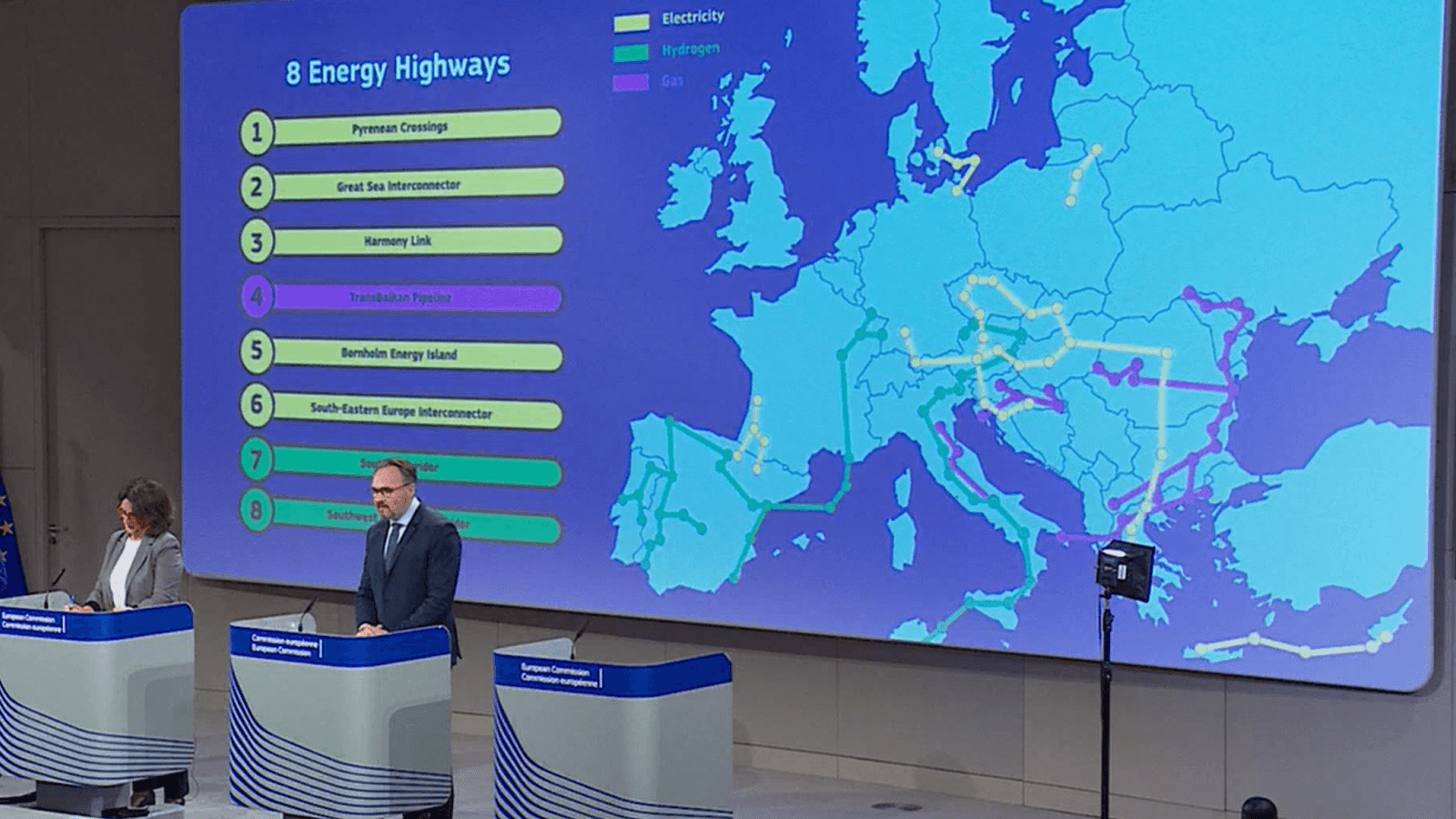
The Energy Highways, first announced by European Commission President Ursula von der Leyen in the State of the Union 2025, are key strategic interconnections that will support the completion of the Energy Union by addressing critical bottlenecks in the EU's energy system.
With the Commission’s proposal, the eight highways will be fast-tracked with targeted support for the Member States and project promoters involved, including leveraging financing and measures to further streamline and accelerate permit-granting processes to help bring the projects to a successful conclusion.
The highways include the Iberian Peninsula electricity interconnections, the Great Sea Interconnector between Cyprus and continental Europe, strengthening electricity interconnection of the Baltic States through the Harmony Link, increasing resilience of energy supplies via the TransBalkan Pipeline, the Bornholm Energy Island, South-East Europe, SouthH2 Corridor, and the Southwest hydrogen corridor.
Said Jørgensen: "These are some of the areas that present significant bottlenecks, holding back the flow of clean and cheap energy throughout our Union. By progressing with these eight strategic links, we will open a new era of energy independence for Europe, while helping to lower energy prices."
Increased budget
With the Commission’s new package proposals, and as part of the 2028-2034 Multi-annual Financial Framework, a five-fold increase is proposed to the CEF-Energy budget, from €5.84 billion to €29.91 billion.
Additionally, domestic grid projects will be eligible for funding under the National and Regional Partnerships Plans and the European Competitiveness Fund.
The Commission estimates that €1.2 trillion ($1.4 trillion) will be needed in the EU's electricity grids until 2040, including €730 billion ($849.2 billion) for distribution grids alone, and €240 billion ($279.2 billion) for hydrogen networks.
Grid infrastructure is mainly financed through tariffs, hence the scale up in financial support.
Additionally, the Commission next year intends to put forward its Clean Energy Investment Strategy for Europe, which will outline concrete ways to remove barriers and unlock private capital for strategic energy transition investments, such as grids.
Said Teresa Ribera, Executive Vice-President for Clean, Just and Competitive Transition:
“Nobody is pretending that the whole set is going to be funded through public budgets so we need to ensure it is financially viable, taking in consideration the time scope [and] how it is appealing to come up with a proposal that ensures that private investors feel that it is a great decision to invest in our grids.”
Smoothing out planning
The new Grids Package proposes an EU cross-border energy infrastructure planning process that enables more coordinated identification of needs, ensuring projects are aligned with both current and future European objectives.
Said Jørgensen: "Imagine trying to piece together a puzzle without looking at the box with the picture.
“To some extent, that’s what we are doing right now with Europe’s energy infrastructure.”
According to Jørgensen, planning is currently done through a bottom-up approach, adding and aligning national plans and sectoral strategies, thereby “missing a truly European and cross-sector perspective.”
As a response, with the package, the Commission says it will develop a comprehensive central EU scenario that is cost-effective and that can help to deliver on the EU energy and climate targets.
This scenario will be developed every four years with the possibility to be updated in case of need.
It will be based on input from Member States and the stakeholders concerned and will serve as the basis for energy system operators (European Network Transmission System Operators and European Network of Network Operators for Hydrogen) to identify infrastructure capacity needs across the EU.
The Commission hopes this will support a more rigorous selection of projects that ensures well-coordinated planning at EU level, avoiding wasted resources.
We are not rolling out our grids fast enough. If we don’t speed up, in 2030, we will lack approximately half of the EU’s new cross border capacity that is needed.
Simplified permitting
The package, in coordination with the EU regulatory framework on environmental protection, establishes an EU-level framework to simplify and accelerate permitting procedures for all grid infrastructure, renewable energy projects, storage projects and recharging stations.
Said Jørgensen: “We are not rolling out our grids fast enough.
“If we don’t speed up, in 2030, we will lack approximately half of the EU’s new cross-border capacity that is needed. The average implementation time for a transmission grid project is more than 10 years, of which more than half is devoted to permitting. That’s way too long and we need that to fundamentally change.”
With the package, and for the first time, says the Commission, it proposes to introduce time limits for the permitting process for all infrastructure projects, storage and recharging stations and further simplifies permitting for small-scale renewable, storage and recharging stations projects.
According to the Commission, it also ensures processes are fully digitalised and national authorities are well-equipped to handle requests effectively.
Additionally, it streamlines environmental assessments for electricity PCIs and PMIs as well as project types with lower environmental impacts, such as repowering of wind turbines and refurbishment of grids. It also introduces tacit approval if permitting authorities do not reply by the permitting deadlines.
‘Gap filling’ process
The package proposes a new ‘gap filling’ process for the electricity system, to be activated by the Commission when there is a need for cross-border capacity that has not yet been met by suitable project proposals.
The Commission cites ENTSO figures that around half of cross-border electricity needs - 41GW - remain unaddressed by 2030.
The new process will be steered by the European Commission and triggered only when necessary.
The exercise will require strong regional cooperation between the Member States involved, and as a first step, the Commission would invite system operators and project promoters in some cases, to propose projects that address unmatched infrastructure needs.
These would be assessed and discussed at regional level before including them in the transmission operators' Ten-Year Network Development Plan (TYNDP). If this process does not lead to the identification of a suitable project, the Commission can launch a call for proposals open to any party.
Next steps
The proposals will now pass to the European Parliament and the Council.
The Commission will continue collaborating with Member States and stakeholders to implement key cross-border energy infrastructure projects.
Related tags
Latest content
+4
What Spain’s blackout means for the US grid and its energy storage future
EU grids tend to be centrally managed whereas the US runs a patchwork of regional systems. Barrett Bilotta of Agilitas Energy examines what can one learn from the other to counter the threat of cascading blackouts.
- Guest/partner contributor
- 31/10/2025
Latest in Digitalisation
All articlesPartner content
+2
New G3 certification: Multi-utility metering over a single communication network
A single communication network for electricity, gas and water meters: G3 certification release V8 enables integrated multi-utility metering with battery-powered devices.
- Guest/partner contributor
- 08/06/2026